
Factor Rates, Fees and APR: Working Out the True Cost of Short-Term Financing
Short-term business financing is priced in a bewildering number of ways: interest rates, factor rates, discount rates, "fees per 30 days", origination charges, draw fees. Some of that variety is genuine; some of it makes products hard to compare. The only reliable way to choose is to convert each offer into two numbers: the total dollars you will pay, and the annualised cost of the money you actually get to use.
This guide explains the pricing methods you are likely to see and works through three examples with round, illustrative figures.
Four ways lenders quote a price
- Interest rate. A percentage charged on the outstanding balance, usually per year. On an amortising loan, the balance falls as you repay, so interest falls too.
- APR (annual percentage rate). An annualised figure meant to include interest and most fees, so offers can be compared. Consumer lending in many countries requires it; business lending often does not, although some US states now require APR-style disclosures for certain commercial financing.
- Factor rate. A multiplier, such as 1.25 or 1.4, applied once to the amount advanced. You repay the advance times the factor, regardless of how quickly you repay. Common with merchant cash advances and some short-term loans.
- Periodic fees. A percentage charged per week or per 30 days, common in invoice factoring and financing. The cost depends on how long the customer takes to pay.
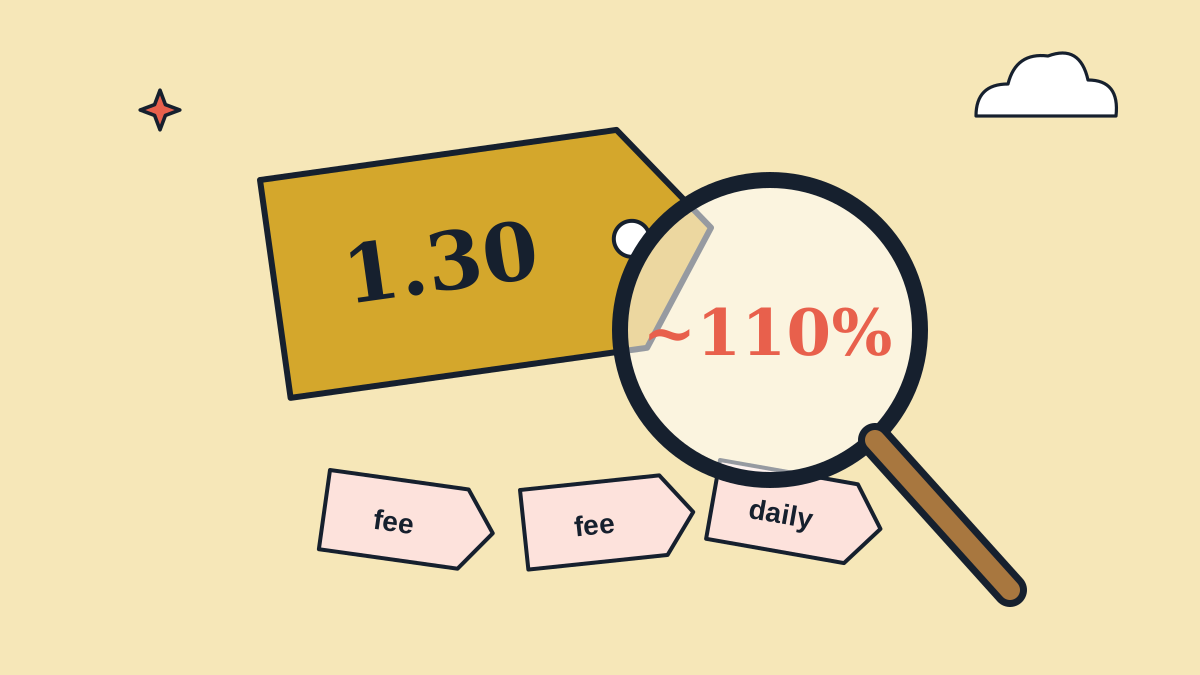
A factor rate of 1.3 sounds like 30%. It is not 30% a year. The 30% is charged in full however short the term, and because repayments usually start immediately, you have the full amount for only a moment. Both effects push the annualised cost far higher.
Example 1: a 12-month term loan with a fee
A lender offers $50,000 over 12 months at 12% annual interest, repaid in equal monthly instalments, with a 3% origination fee deducted from the funds.
- Monthly repayment: about $4,442
- Total interest over the year: about $3,309
- Origination fee: $1,500, so you actually receive $48,500
- Total cost: about $4,809
The quoted rate is 12%, but because the fee reduces what you receive while repayments are based on the full $50,000, the effective APR works out to roughly 18%. Fees matter more the shorter the term: the same $1,500 fee spread over five years would add much less to the annual rate.
Example 2: a merchant cash advance with a 1.3 factor rate
A provider advances $50,000 with a factor rate of 1.30, collected through equal debits on each business day for about six months (126 business days).
- Total repayment: $50,000 × 1.30 = $65,000
- Daily debit: about $516
- Total cost: $15,000
Here is the catch. Repayments begin the next business day, so the amount you still have falls steadily from $50,000 to zero. On average over the six months you are using only about half of it. Paying $15,000 for the use of roughly $25,000 for half a year is a very different proposition from "30%". Run through a standard APR calculation, this example comes out at roughly 110% a year.
That does not automatically make every advance a bad decision; there are situations where speed matters more than price. But it should be compared on the same basis as other options, and repaying early often saves nothing because the factor is fixed.
Example 3: invoice factoring
A factor buys a $20,000 invoice, advances 85% ($17,000) immediately, and charges a fee of 3% of the invoice value for each 30 days until the customer pays. The customer pays in 30 days, and the factor then releases the remaining $3,000 minus its $600 fee.
The $600 fee bought you the use of $17,000 for 30 days. That is about 3.5% for the month, or roughly 43% annualised on a simple basis. If the customer takes 45 days and the factor charges in 30-day blocks, the fee doubles to $1,200 and the annualised cost rises further. Some factors also add set-up, service or minimum-volume fees.
| Offer | Headline price | Total cost | Approx. annualised cost |
|---|---|---|---|
| 12-month loan, $50k | 12% interest + 3% fee | $4,809 | ~18% |
| Merchant cash advance, $50k | 1.30 factor rate | $15,000 | ~110% |
| Factoring, $20k invoice | 3% per 30 days | $600 | ~43% |
All figures are illustrative. Real offers vary widely by lender, business and market conditions.
How to compare any offer yourself
- Ask for the total repayment in dollars, and subtract what you actually receive after fees. That is your total cost.
- Ask for the repayment schedule: amount and frequency of every payment.
- Ask for an APR. If the provider will not give one, put the amount received and the payment schedule into a spreadsheet and use the IRR or RATE function to annualise it.
- Check what happens if you repay early: do you save anything?
- List every fee: origination, draw, service, renewal, late, early termination.
- Compare the annualised cost with what the money will earn. Funding stock that sells at a 40% gross margin within six weeks can justify a higher cost than funding a gap with no return.
Frequently asked questions
Why don't all business lenders show an APR?
Rules for commercial lending differ from consumer lending, and in many places lenders are not required to disclose an APR to businesses. Some US states have introduced disclosure rules for certain commercial financing. You can always ask, and you can calculate one yourself from the schedule.
Is a high APR always a bad deal?
Not always. A very short, small bridge can have a high APR but a modest dollar cost. The danger is using expensive short-term money for long or repeated needs, where the dollar cost compounds.
What is "stacking"?
Taking a second or third advance while earlier ones are still being repaid. Each adds another daily debit, which can quickly overwhelm cash flow. Many advance agreements prohibit it.
Related articles
Working Capital Financing Options Compared: Lines of Credit, Factoring, MCAs and More
How each option works, what it suits, and the catches to check before you sign.

How to Get Paid Faster: A Practical Accounts Receivable Playbook
Invoicing habits, an aging report walkthrough, and a follow-up schedule that stays friendly.

Seasonal Cash Flow: How to Survive the Slow Months and Fund the Busy Ones
A month-by-month example that finds the cash trough, plus ways to fund the stock build.