
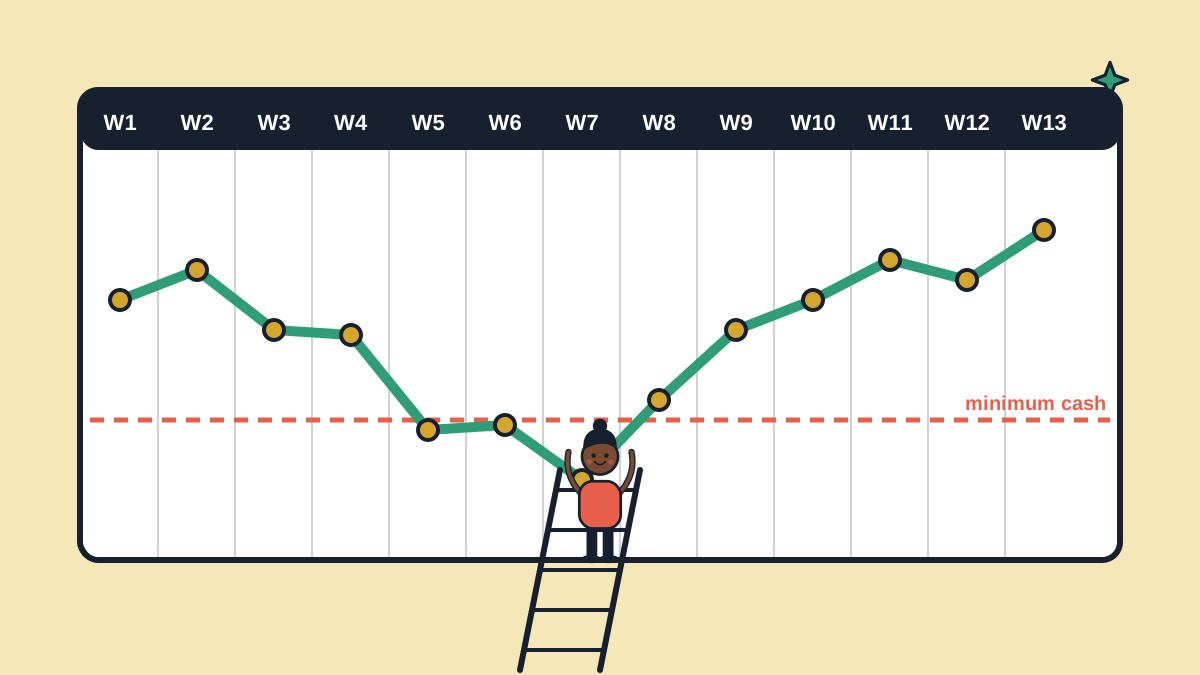
Balance sheets and ratios tell you where you stand on one day. A 13-week cash flow forecast tells you where you are heading, week by week, for the next quarter. It is the tool turnaround specialists reach for first in a crisis, and one of the most useful habits a healthy small business can build.
Why thirteen weeks? It is one quarter: long enough to see a problem coming with time to act, short enough that you can forecast with reasonable accuracy from invoices and bills you already know about.
What goes into the forecast
A 13-week forecast is built on cash, not accounting profit. The only question for each line is: in which week will money actually leave or arrive in the bank? That means:
- Customer receipts appear in the week you expect to be paid, not the week you invoiced.
- Supplier payments appear in the week you plan to pay them, based on their terms.
- Non-cash items such as depreciation are left out entirely.
- Items that never appear on the profit and loss statement, such as loan principal, owner drawings, equipment purchases and sales tax payments, are included.
Building it in six steps
1. Set up the grid
In a spreadsheet, put thirteen week-commencing dates across the top. Down the side, list: opening cash; receipts by type; payments by type; net cash flow; closing cash; and a minimum cash line.
2. Start from the real bank balance
Week 1's opening cash is today's balance across all business bank accounts. Each subsequent week's opening is the previous week's closing.
3. Forecast receipts
Start from your receivables aging report: for each open invoice, estimate the week it will actually be paid, using each customer's real habits rather than the printed terms. Then add expected receipts from sales you have not yet made, based on recent weekly averages and any known seasonality. Be conservative; it is better to be pleasantly surprised.
4. Forecast payments
List fixed items first: payroll dates, rent, loan repayments, insurance, subscriptions, and tax deadlines. Then add supplier payments from your payables list and planned purchases. Put each in the week it will leave the account.
5. Calculate net and closing cash
Net cash flow is receipts minus payments. Closing cash is opening plus net. Draw a minimum cash line, the lowest balance you are comfortable holding, which many owners set at two to four weeks of essential outgoings.
6. Flag the weeks below the line
Any week where closing cash dips below your minimum is a problem you now know about in advance. That is the whole point.
Worked example: the first six weeks
Here is the start of a forecast for an illustrative catering company with $20,000 in the bank, fortnightly payroll and a minimum cash target of $10,000.
| Week | Customer receipts | Payroll | Suppliers | Rent, tax, loan, other | Net | Closing cash |
|---|---|---|---|---|---|---|
| 1 | 14,000 | 0 | 6,000 | 6,000 | +2,000 | 22,000 |
| 2 | 11,000 | 9,000 | 5,000 | 2,700 | −5,700 | 16,300 |
| 3 | 12,500 | 0 | 7,500 | 5,300 | −300 | 16,000 |
| 4 | 9,000 | 9,000 | 4,000 | 2,700 | −6,700 | 9,300 |
| 5 | 13,000 | 0 | 6,500 | 6,000 | +500 | 9,800 |
| 6 | 10,500 | 9,000 | 5,500 | 2,700 | −6,700 | 3,100 |
The business looks fine in week 1, but the forecast shows cash drifting below the $10,000 minimum in week 4 and close to empty by week 6, mainly because payroll weeks combine with a quarterly sales tax payment in week 3 and slower receipts in week 4. With five weeks' warning, the owner has real options: chase two large overdue invoices now, ask a supplier to split a payment, move a non-urgent equipment purchase, or arrange a small draw on a credit line before it is urgent. Discovered in week 6, the same problem would leave far fewer choices.
The weekly routine
A forecast is only useful if it stays current. Once it is built, maintaining it takes about half an hour a week:
- Replace last week's forecast figures with actuals from the bank.
- Note the biggest differences between forecast and actual, and why.
- Roll forward: drop the finished week and add a new week 13.
- Update receipts from the latest aging report and new sales.
- Update payments for new bills and any changes in timing.
- Check every week against your minimum cash line and decide on any action.
Over time, comparing forecast to actual makes you a better forecaster. If receipts are always lower than you expected, you are too optimistic about customer payment habits, and your collections process may need attention.
Common mistakes
- Using sales instead of receipts. An invoice raised in week 2 on 30-day terms is cash in week 6 or later.
- Forgetting lumpy items: quarterly taxes, annual insurance, loan balloon payments, software renewals, bonuses.
- Leaving out owner drawings or personal amounts paid from the business account.
- Building it once and never updating it. A stale forecast is worse than none because it creates false confidence.
- Ignoring the pattern. If every forecast shows a dip in the same weeks, you may have a seasonal pattern or a structural gap worth solving once.
Frequently asked questions
Do I need special software?
No. A spreadsheet is perfectly adequate for most small businesses. Some accounting and cash-management tools can pre-fill forecasts from your invoices and bills, which saves time once the business grows.
How accurate should it be?
Weeks one to four should be quite close because they are mostly known invoices and bills. Weeks nine to thirteen will be rougher. The aim is to spot direction and pinch points, not to predict every dollar.
Will lenders want to see it?
Many lenders and advisers value a well-kept weekly forecast, particularly if you are asking for a credit line or going through a difficult period. It shows you understand your cash and are managing it actively.
Related articles

Seasonal Cash Flow: How to Survive the Slow Months and Fund the Busy Ones
A month-by-month example that finds the cash trough, plus ways to fund the stock build.
Negative Working Capital: Clever Business Model or Warning Sign?
Why some cafés and subscription businesses run negative on purpose, and the signs that it is trouble.

Why Growth Eats Cash: Profitable, Growing and Still Running Out of Money
How a profitable, growing business can run short of cash, and how to see it coming.