
Home / Articles / The cash cycle
The cash cycleThe Cash Conversion Cycle: How Many Days Your Money Is Stuck
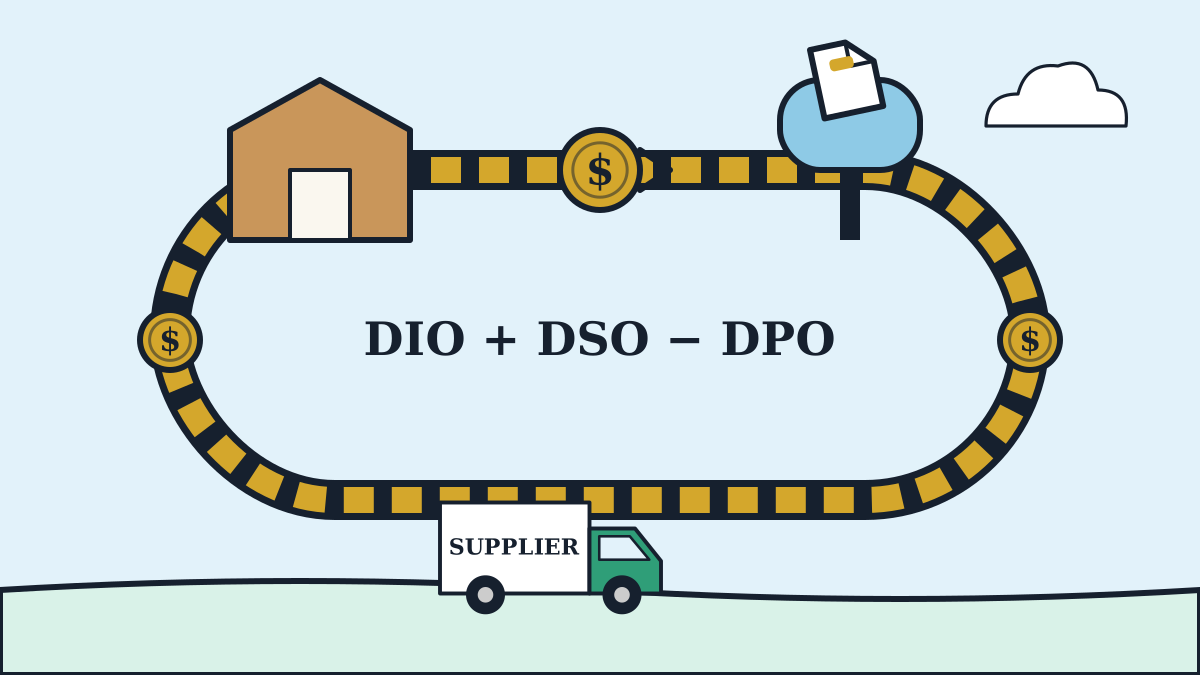
Every business that buys before it sells has a gap: money goes out to suppliers, sits in stock, becomes an invoice, and only later comes back as cash. The cash conversion cycle (CCC) measures that gap in days. The longer it is, the more working capital the business needs just to keep trading.
It is one of the most practical numbers in small-business finance because it breaks a vague worry ("we never seem to have cash") into three levers you can actually pull.
The formula in three parts
CCC = DIO + DSO − DPO
- DIO = average inventory ÷ cost of goods sold × 365. How many days, on average, stock is held before it is sold.
- DSO = average accounts receivable ÷ revenue × 365. How many days, on average, customers take to pay. Strictly you should use credit sales only; if most sales are on invoice, total revenue is a fine approximation.
- DPO = average accounts payable ÷ cost of goods sold × 365. How many days, on average, you take to pay suppliers.
"Average" usually means the opening balance plus the closing balance for the year, divided by two. If your business is seasonal, averaging twelve month-end balances gives a truer figure.
Worked example: a small furniture workshop
Imagine a workshop that builds tables and sells mostly to interior designers on invoice. Over the last year (illustrative figures):
| Item | Figure | Result |
|---|---|---|
| Revenue | $1,200,000 | |
| Cost of goods sold | $720,000 | |
| Average inventory (timber, hardware, finished pieces) | $120,000 | DIO = 120,000 ÷ 720,000 × 365 ≈ 60.8 days |
| Average receivables | $150,000 | DSO = 150,000 ÷ 1,200,000 × 365 ≈ 45.6 days |
| Average payables | $60,000 | DPO = 60,000 ÷ 720,000 × 365 ≈ 30.4 days |
| Cash conversion cycle | 60.8 + 45.6 − 30.4 ≈ 76 days |
So from the moment the workshop pays for timber to the moment a designer's payment clears, about 76 days pass on average. Every sale has to be funded by the business for roughly two and a half months.
Try it with your own numbers
What is a day worth?
The cycle becomes really useful when you convert days into dollars. Because receivables scale with revenue, each day of DSO in the example is worth about $1,200,000 ÷ 365 ≈ $3,288. Each day of inventory or payables is worth about $720,000 ÷ 365 ≈ $1,973.
- Cutting DSO by 10 days (say from 46 to 36) would release roughly $32,900 that is currently sitting in unpaid invoices.
- Cutting DIO by 10 days would release roughly $19,700 currently sitting on shelves.
- Negotiating 10 extra days with suppliers would keep roughly $19,700 in the bank for longer.
That is cash freed once, not every year, but for a business of this size it can be the difference between needing a credit line and not. It also compounds with growth: the faster sales rise, the more cash a long cycle absorbs, a problem covered in why growth eats cash.
Pulling each lever without breaking something
Lower DIO
Order closer to demand, cut slow-moving product lines, and set reorder points based on real sales rather than habit. The inventory guide goes through reorder points and ABC analysis. The risk is running out of popular items, so keep safety stock on your best sellers.
Lower DSO
Invoice on the day of delivery, take deposits on custom work, make paying electronic and easy, and follow up on a schedule. Our receivables playbook has a full collection cadence. The risk is irritating good customers, so be firm but friendly.
Raise DPO
Ask for longer terms once you have a record of paying on time, and pay on the due date rather than early unless there is a discount worth taking. Supplier terms explains how to work out whether an early-payment discount beats holding the cash. The risk is damaging relationships or incurring late fees, so never "stretch" past agreed terms without talking to the supplier.
Reading the result
There is no universal target. A grocery store may have a cycle near zero or even negative, while a manufacturer with long production runs may sit above 100 days. Compare your cycle with your own history first and with businesses that sell similar things second. A cycle that lengthens quarter after quarter, especially if DSO is the part growing, is worth investigating before it shows up as a cash shortfall.
Frequently asked questions
Does a service business have a cash conversion cycle?
Yes, though DIO is usually zero or close to it. For an agency or consultancy the cycle is mostly DSO minus DPO, and because the biggest cost is wages, which are paid on a fixed schedule, DSO is the lever that matters most.
Why use cost of goods sold for DIO and DPO but revenue for DSO?
Inventory and payables are recorded at cost, while receivables are recorded at selling price. Matching each balance to the flow measured on the same basis keeps the days meaningful.
Is a negative cash conversion cycle possible?
Yes. If customers pay before you pay suppliers and stock moves quickly, the cycle can drop below zero, meaning suppliers are effectively funding the business. It is common in food retail and some online sellers.
How often should I recalculate it?
Quarterly works for most small businesses. Monthly is useful during rapid growth, a new product launch, or when you are negotiating financing.
Related articles

How to Get Paid Faster: A Practical Accounts Receivable Playbook
Invoicing habits, an aging report walkthrough, and a follow-up schedule that stays friendly.
The Inventory Cash Trap: How Stock Quietly Eats Working Capital
Turnover, carrying costs, reorder points and ABC analysis, explained with shelf-level examples.

Supplier Payment Terms Decoded: Net 30, 2/10 Net 30 and When to Pay Early
Net 30, 2/10 net 30 and EOM decoded, plus the math on whether an early-pay discount is worth it.