
Current Ratio vs Quick Ratio: Which Liquidity Test Matters for a Small Business?
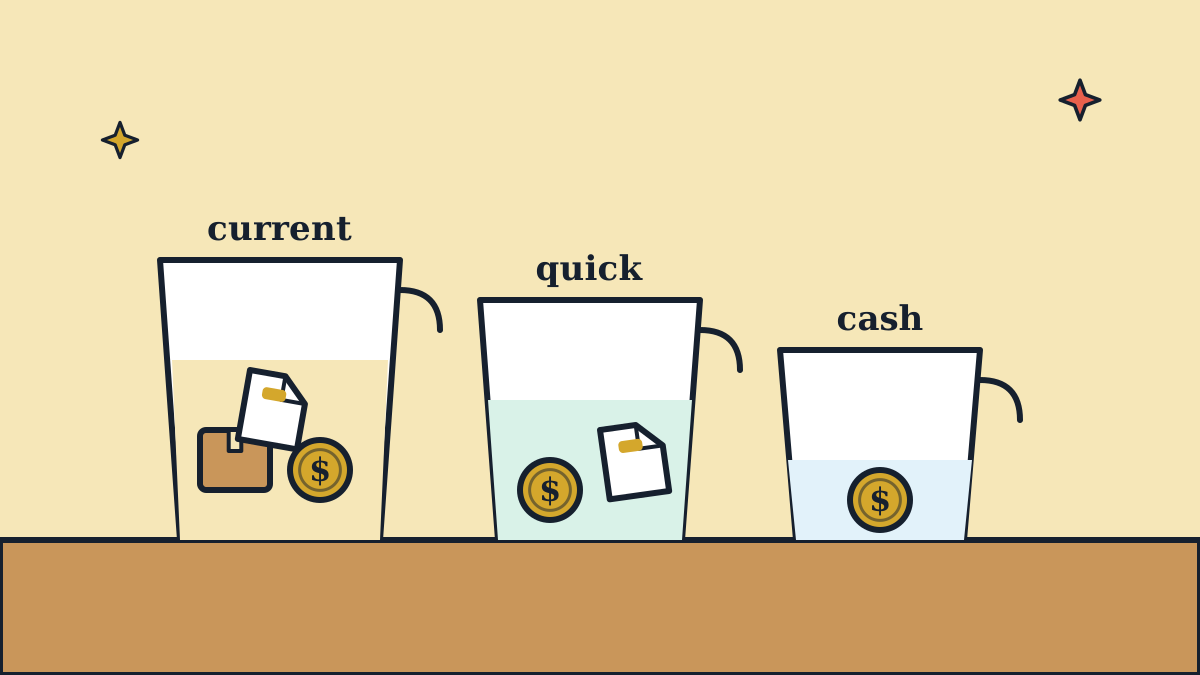
Working capital tells you the size of the cushion in dollars. Liquidity ratios tell you how thick that cushion is relative to what you owe, which makes them easier to compare across months, across businesses of different sizes, and against the covenants a lender may write into a loan agreement.
There are three ratios worth knowing. Each asks the same question, "can this business pay its short-term bills?", but each is stricter than the last about what it is willing to count as money.
The current ratio
Current ratio = Current assets ÷ Current liabilities
This is the broadest test. It counts every current asset, including inventory and prepaid expenses. A ratio of 1.0 means current assets exactly match current liabilities; 2.0 means there are two dollars of short-term resources for every dollar of short-term obligations.
Using the illustrative shop from our working capital explainer, with $72,000 of current assets and $40,000 of current liabilities, the current ratio is 72,000 ÷ 40,000 = 1.8.
The quick ratio (acid test)
Quick ratio = (Cash + Short-term investments + Receivables) ÷ Current liabilities
The quick ratio drops inventory and prepaid expenses. The reasoning is practical: if a business suddenly had to pay its bills, it could chase invoices and sell investments fairly quickly, but it could not count on selling all of its stock at full value in a hurry, and it certainly cannot turn last month's prepaid insurance back into cash.
Some textbooks write the formula the other way round, as current assets minus inventory minus prepaids, divided by current liabilities. For a simple balance sheet the answer is the same.
For the example shop: ($18,000 cash + $12,000 receivables) ÷ $40,000 = 0.75. That is a very different picture from the current ratio of 1.8. The shop can cover its bills comfortably only if it keeps selling stock at a normal pace.
The cash ratio
Cash ratio = (Cash + Short-term investments) ÷ Current liabilities
The strictest test counts only money that is already in hand. For the shop it is 18,000 ÷ 40,000 = 0.45. Very few healthy small businesses keep enough cash to cover every short-term liability at once, and there is no reason they should: bills fall due across the year, not all on one day. The cash ratio is most useful as a stress test, or when you are worried about a specific customer paying late.
| Ratio | Counts | Example result | Question it answers |
|---|---|---|---|
| Current | All current assets | 1.80 | Over the next year, will short-term resources cover short-term bills? |
| Quick | Cash, investments, receivables | 0.75 | Can we pay without relying on selling stock? |
| Cash | Cash and near-cash only | 0.45 | How much could we pay today with money already in the bank? |
What is a "good" ratio?
You will often see rules of thumb such as "a current ratio between 1.5 and 2 is healthy" and "a quick ratio of about 1 is comfortable". These are reasonable starting points, but they were never laws, and they break down quickly across industries:
- Retailers and wholesalers carry a lot of inventory, so their quick ratios tend to sit well below their current ratios. A quick ratio under 1 is common and not necessarily worrying if stock turns quickly.
- Service businesses such as agencies and consultancies hold little or no stock, so their current and quick ratios are nearly identical. For them, receivables quality is the whole story.
- Cash-up-front businesses like cafés, gyms and subscription software can run current ratios below 1 for years without distress, because customers pay before costs are due. See when negative working capital is fine.
A ratio can also be too high. A current ratio of 5 might mean a pile of idle cash that could be paying down expensive debt, or a warehouse of slow-moving stock that is quietly losing value. The inventory guide covers that trap in more detail.
How lenders use these ratios
Banks and other lenders commonly look at liquidity ratios when deciding whether to extend a line of credit, and some loan agreements include a covenant: a promise to keep, say, the current ratio above an agreed minimum, tested at each quarter-end or year-end. Breaching a covenant does not automatically mean the loan is called in, but it gives the lender the right to renegotiate, charge fees or, in serious cases, demand repayment. If you have a facility with covenants, it is worth knowing exactly how the lender defines each term, because definitions sometimes differ from textbook versions (for example, excluding amounts owed by related companies).
Reading ratios well
- Watch the trend. A current ratio sliding from 2.1 to 1.4 over four quarters says more than any single number.
- Measure at comparable points. Seasonal businesses should compare March to last March, not March to December.
- Beware window dressing. Paying down a supplier the day before year-end, or delaying a stock order, can flatter a ratio without changing the underlying position.
- Look through to quality. A strong quick ratio built on a single large, overdue invoice is not strong.
- Pair ratios with cash timing. Ratios are snapshots; a weekly cash forecast shows whether the timing works.
Frequently asked questions
Why is it called the acid test?
The name borrows from an old method of testing gold with acid: genuine gold survived, base metals did not. The quick ratio similarly strips away the less certain assets to see whether the business still holds up.
Should I include my business credit card in current liabilities?
Yes. Any balance you owe on a card is a short-term obligation, even if you pay it off every month. Leaving it out flatters every ratio.
Can a ratio below 1 still be safe?
It can, if the business collects cash from customers before it has to pay suppliers and the model is stable. It is riskier when the low ratio comes from overdue bills or short-term borrowing that is funding losses.
How often should I calculate these?
Monthly is a sensible rhythm for most small businesses, once the books are reconciled. Quarterly is the minimum if you have lender covenants to watch.
Related articles
What Is Working Capital? The Formula, Explained With a Real-Looking Example
The formula, what counts on each side, and a worked example from a small homewares shop.

The Inventory Cash Trap: How Stock Quietly Eats Working Capital
Turnover, carrying costs, reorder points and ABC analysis, explained with shelf-level examples.
Working Capital Financing Options Compared: Lines of Credit, Factoring, MCAs and More
How each option works, what it suits, and the catches to check before you sign.